shanavk.com

Uncategorized

Uncategorized

How AI Is Changing Digital Marketing in 2026 and Beyond

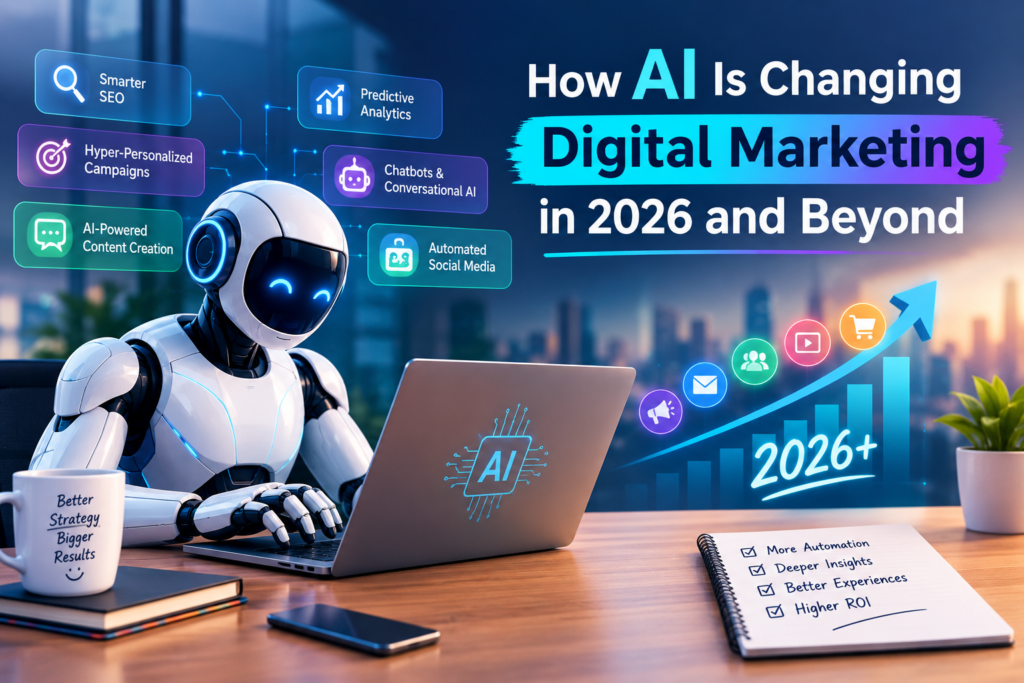
How AI Is Changing Digital Marketing in 2026 and Beyond A few years ago, using AI in Digital Marketing meant experimenting with a chatbot or trying a caption generator out of curiosity. In 2026, it has become part of the everyday toolkit for marketers, freelancers and small business owners. From planning content to analyzing campaign performance, AI now supports work that used to take hours of manual effort. This shift is not about machines replacing marketers. It is about marketers learning to work alongside AI to save time, generate ideas faster and make better decisions. Whether you run a fashion boutique in Kochi, manage social media for a Kerala based restaurant, or are just starting out as a digital marketer, understanding how AI fits into this space is becoming essential.   What Is AI in Digital Marketing? AI in Digital Marketing refers to the use of artificial intelligence tools and technologies to support marketing tasks such as content creation, audience research, advertising, customer communication and data analysis. Instead of doing everything manually, marketers use AI to speed up repetitive work and get useful suggestions based on data. This can include things like generating blog outlines, writing ad variations, analyzing customer behavior, automating email replies or personalizing website content. AI does not replace strategy. It supports it.   Why Is AI Becoming Important for Digital Marketers in 2026? Digital marketing has become more competitive and more data heavy than ever. Consumers expect fast responses, personalized experiences and relevant content across multiple platforms. Meeting these expectations manually is difficult, especially for small teams or solo marketers. AI helps by handling repetitive tasks such as drafting content, sorting data and monitoring performance, which frees up time for strategic thinking. This is one reason more businesses, including small and local ones, are exploring affordable AI tools rather than only large enterprises.   How AI Is Changing Content Creation Content creation is one of the areas where AI in Digital Marketing has had the most visible impact. Marketers now use AI to assist with: Generating content ideas and topic lists Creating blog outlines Drafting social media captions Brainstorming video concepts Planning content calendars Doing quick research summaries Editing and improving grammar or tone Personalizing content for different audience segments That said, human input remains essential. AI generated drafts often need editing for accuracy, tone and brand voice. A human touch is what keeps content authentic and aligned with what a brand actually stands for.   AI and Social Media Marketing AI tools help marketers understand what type of content their audience engages with, suggest posting times and generate content ideas based on trends. They can also assist with analyzing comments and messages to understand audience sentiment. For example, a Kerala based content creator could use AI to quickly brainstorm reel ideas around a local festival, then refine the concept based on their own understanding of their audience and cultural context. The idea comes from AI, but the final creative direction still needs a human perspective.   AI and SEO AI is influencing how search itself works. Alongside traditional SEO, marketers are now paying attention to AI search and a newer concept called Generative Engine Optimization, or GEO, which focuses on how content appears in AI generated answers rather than only traditional search listings. This does not mean traditional SEO has become irrelevant. Search engines still value well structured, relevant and trustworthy content. AI simply adds another layer marketers need to consider, alongside keyword research, quality writing and good website structure.   AI in Digital Advertising In advertising, AI is commonly used for audience targeting, ad copy variations, creative testing and campaign performance analysis. Instead of manually testing dozens of ad versions, marketers can use AI to generate multiple options and identify patterns in what performs better. This is particularly useful for small businesses with limited advertising budgets, since it reduces the guesswork involved in testing different messages.   AI and Customer Experience Chatbots, automated replies and recommendation systems are now common on websites and social media pages. These tools help businesses respond to customer queries faster, even outside business hours. An online store, for instance, could use a simple AI chatbot to answer common questions about delivery time or return policy, while more complex queries are still handled by a human team member.   Benefits of AI in Digital Marketing Saves time on repetitive tasks Speeds up content ideation Supports automation of routine work Improves personalization at scale Helps analyze data more efficiently Increases overall productivity Enables faster decision making   Challenges of Using AI in Digital Marketing AI is useful, but it comes with limitations that marketers should keep in mind. AI generated information can sometimes be inaccurate and needs fact checking Content can feel generic if used without editing AI cannot fully replicate human emotion or lived experience Overdependence on AI can weaken a brand’s unique voice Privacy concerns exist around data used by AI tools Human review remains necessary before publishing AI assisted content AI and Human Creativity AI in Digital Marketing works best as a tool, not a replacement for human creativity. Strategy, storytelling, emotional understanding and cultural context are areas where human marketers continue to add irreplaceable value. A brand’s personality, tone and the trust it builds with its audience often come from human decisions, not algorithms. AI can support the process, but it cannot replace the judgment that comes from experience and cultural understanding.   The Future of AI in Digital Marketing Looking beyond 2026, AI is likely to become even more integrated into everyday marketing workflows. It may become more common to see AI assisting with deeper personalization, faster campaign testing and more advanced content planning. These are possibilities rather than certainties, since technology and consumer behavior can change in unexpected ways. What seems more likely is that marketers who combine AI skills with strong human creativity, strategic thinking and originality will be better positioned for the future.   Conclusion AI in Digital Marketing is not about […]
Uncategorized

What Is GEO? The New SEO Strategy for AI Search in 2026”

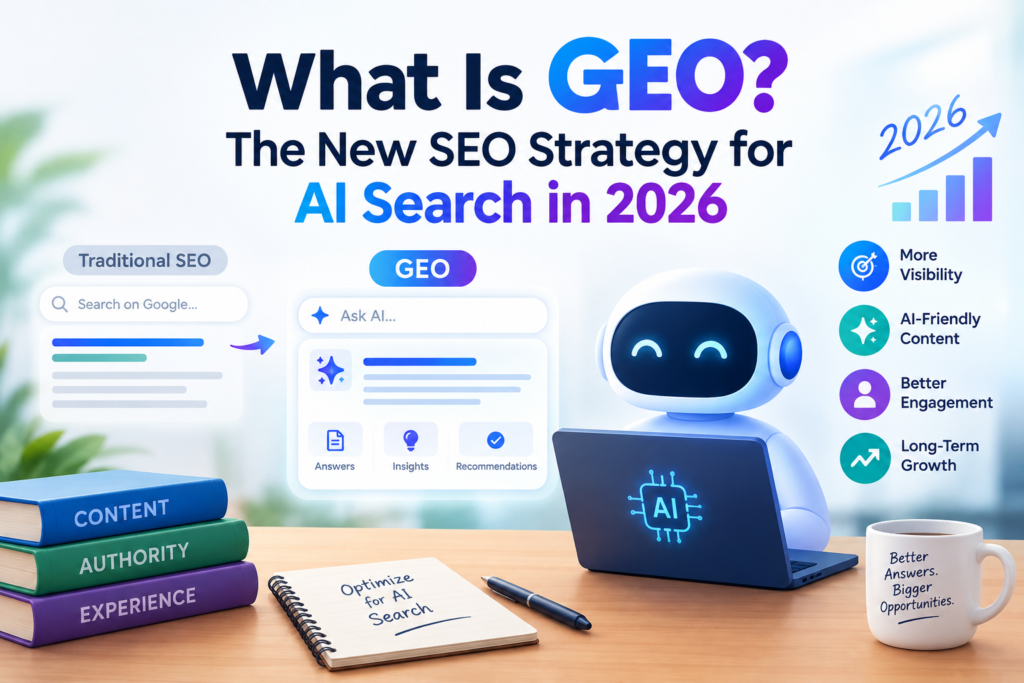
What Is GEO? The New SEO Strategy for AI Search in 2026 The way people search for information has been changing quietly for the last couple of years. Instead of typing a query into Google and scrolling through ten blue links people are now asking tools like ChatGPT Google AI and other AI search assistants direct questions and getting direct answers. This shift has created a new area of focus for marketers called Generative Engine Optimization or GEO. If you run a business a blog or a personal brand in India or Kerala this shift matters to you too. Understanding GEO now can help you stay visible as more people rely on AI search engines to find products services and information.   What Is GEO? Generative Engine Optimization refers to the practice of creating content that is more likely to be picked up understood and used by AI search tools when they generate answers for users. Instead of only ranking on a search results page your content aims to become a source that an AI system references or summarizes when answering someone’s question. GEO does not replace SEO. It builds on the same foundation of good content but adds a new layer of thinking about how AI systems read summarize and trust information.   GEO vs Traditional SEO Traditional SEO focuses on ranking a webpage on a search engine results page using keywords backlinks site speed and other ranking factors. The goal is to get a user to click on your link. GEO focuses on something slightly different. It looks at whether your content is clear enough accurate enough and well structured enough for an AI system to pull information from it directly. Sometimes a user may never click through to your website at all. They simply get an answer generated with your content as one of the sources. This does not mean traditional SEO is no longer useful. Strong SEO fundamentals like quality content and technical site health still matter. GEO simply adds another goal on top of that foundation.   Why GEO Matters in 2026 More people are using AI powered assistants as their first step when searching for information rather than typing into a traditional search bar. Marketers and business owners are paying attention to this because visibility inside AI generated answers is becoming another important channel alongside traditional search rankings. For a digital marketer in India this means content strategy can no longer focus only on ranking keywords. It also needs to consider how AI tools interpret and use that content.   How Does GEO Work? While no one can guarantee how every AI system chooses its sources certain practices consistently help. Give clear direct answers early in your content Write original and genuinely helpful information rather than generic filler Cover a topic thoroughly instead of writing thin surface level content Keep information accurate and up to date Use clear structure with proper headings Write in natural conversational language Include relevant real world examples Build author credibility by writing from real experience Add useful FAQs that answer common questions directly These principles overlap heavily with what already makes content genuinely useful to human readers which is part of why good content strategy still works well for GEO.   GEO and SEO Working Together Businesses should think of GEO as an extension of their existing search strategy rather than a reason to abandon SEO. A well optimized fast loading website with strong content is still valuable for traditional search rankings. GEO simply asks you to also think about clarity structure and trustworthiness from an AI system’s point of view. Trying to choose one over the other is unnecessary. The two approaches support each other.   How Can Businesses Use GEO? Consider a small ayurvedic skincare brand based in Kerala. If someone asks an AI assistant about natural skincare ingredients from Kerala having clear well structured content explaining ingredients benefits and usage increases the chance of being referenced in that answer. A restaurant in Kochi could benefit by clearly listing its specialty dishes cuisine type and location details in a way that is easy for AI tools to understand rather than burying that information in vague marketing language. An educational institution in Kerala offering specific courses can gain visibility by publishing clear accurate information about course details eligibility and outcomes so that AI tools can confidently reference it when students ask related questions. Indian startups and service businesses can apply the same thinking by ensuring their websites clearly explain what problem they solve and for whom rather than relying only on branding language.   GEO for Content Creators and Digital Marketers Bloggers social media marketers and personal brands should think beyond just keyword rankings. Creating content that thoroughly answers a question in a natural human tone tends to perform well for both traditional SEO and GEO. Digital marketers should also focus on establishing credibility. Author bios clear expertise and consistent publishing on a topic help build the kind of trust signals that both search engines and AI systems value.   Common GEO Mistakes to Avoid Some habits can hurt your visibility in AI search results. Stuffing keywords unnaturally into content Publishing thin content that does not fully answer a question Copying content from other websites Writing only for search engines instead of real readers Sharing inaccurate or outdated information Publishing generic AI generated content without human review or editing Avoiding these mistakes matters more in the GEO era because AI systems tend to favor content that is clear accurate and genuinely helpful.   How to Start GEO as a Beginner If you are just getting started here is a simple approach. Begin by reviewing your existing content and checking whether it answers common questions clearly. Add an FAQ section to your important pages. Make sure your headings are clear and your information is accurate and current. Focus on writing content a real person would find genuinely useful rather than content written only to rank. Over time expand […]

Uncategorized

AI Content Creation: How to Use AI Without Losing Human Creativity

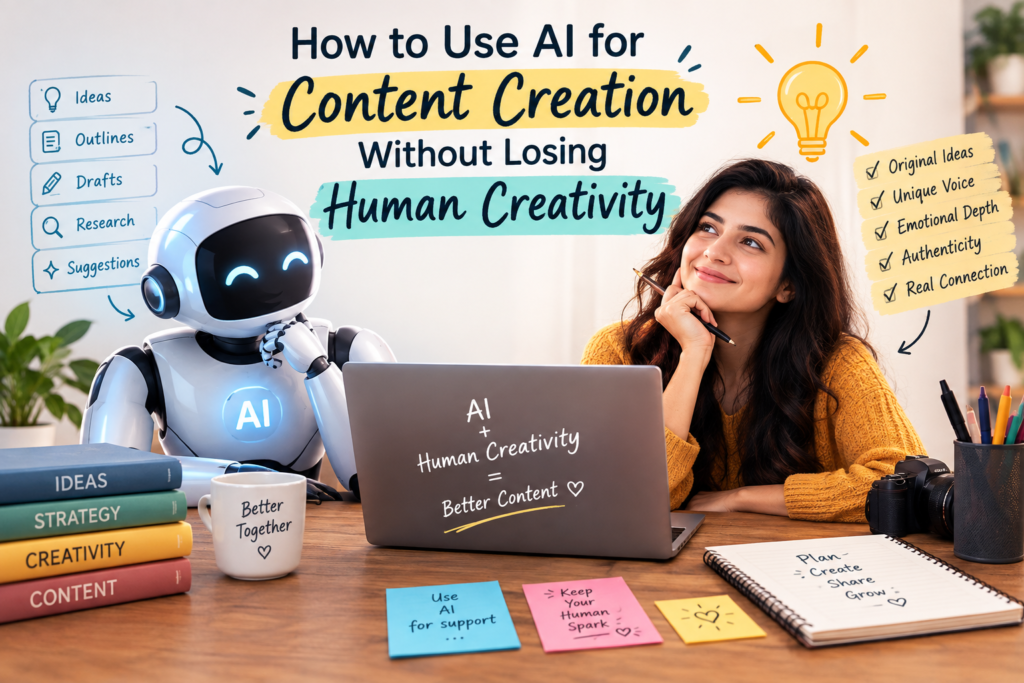
AI Content Creation: How to Use AI Without Losing Human Creativity AI content creation has become one of the biggest shifts in digital marketing over the last few years. Content creators bloggers and marketers across India and Kerala are now using AI tools daily to write faster produce more content and save time. But this shift has also brought a common worry. Will AI content creation make everything sound the same? Will it remove the human touch that makes content memorable? The good news is that AI content creation does not have to replace human creativity. When used the right way AI becomes a support system rather than a replacement. This article explains what AI content creation actually means why it matters and how you can use it without losing your own voice.   What Is AI Content Creation? AI content creation simply means using artificial intelligence tools to help produce written visual or audio content. This can include blog posts social media captions product descriptions video scripts and even basic graphic designs. Popular AI writing tools can generate drafts summarize information and suggest ideas within seconds. For many content creators this technology has changed how content gets made. What used to take hours of research and drafting can now be done much faster. But speed is only useful when the final content still feels authentic and human.   Why Are Marketers Using AI for Content Creation? Digital marketers are adopting AI content creation for a few clear reasons. It saves time on research and first drafts It helps generate multiple content ideas quickly It supports consistent posting schedules It reduces the workload for small teams A small digital marketing agency in Kerala for example might handle several client accounts at once. Using AI content tools for outlines and first drafts allows the team to focus more energy on strategy and client relationships rather than spending hours on basic writing tasks.   The Role of Human Creativity in AI Content Creation This is the part that gets overlooked most often. AI can generate text but it cannot generate genuine experience. It does not know what it feels like to run a family business in Kochi survive a tough monsoon season or celebrate a local festival with customers. Human creativity brings emotion opinion humor and cultural understanding into content. These are the elements that make people stop scrolling and actually connect with what they are reading. AI content creation works best when it is guided by a real person with real insight not left to run completely on its own.   How to Use AI Without Making Content Feel Robotic A lot of AI generated content feels flat because people use it the wrong way. Here is how to avoid that. Start with your own thoughts first. Write a few rough lines or bullet points before opening any AI tool. This way AI is refining your idea instead of creating one from nothing. Edit everything AI gives you. Never publish an AI draft as it is. Remove generic phrases replace safe sounding lines with your own opinion and adjust the tone so it matches how you actually speak. Add specific details. A real customer story a personal observation or a local reference makes content believable. AI cannot invent these convincingly and should not be asked to.   Practical Ways to Combine AI and Human Creativity The best content workflows use AI and human input together rather than choosing one over the other. You can use AI for: Research and background information Content outlines and structure Grammar and clarity checks Generating multiple headline options You should keep for yourself: Personal stories and opinions Emotional tone and voice Final editing decisions Cultural context that only you understand This kind of division keeps the process efficient while protecting what makes your content genuinely yours.   Common Mistakes to Avoid When Using AI for Content Many beginners make the same mistakes when starting with AI content creation. Publishing AI output without any editing Using the same prompt style for every piece of content Ignoring factual accuracy and not checking AI generated claims Losing personal voice by relying too heavily on AI phrasing Skipping the research step and trusting AI completely for facts Avoiding these mistakes is often the difference between content that performs well and content that feels forgettable.   How Beginners Can Start Using AI for Content Creation If you are new to this here is a simple way to begin. Pick one small task first such as writing a social media caption or an email subject line. Use an AI tool to generate a rough version then rewrite it in your own words. Repeat this with different types of content over a few weeks. Slowly you will understand where AI genuinely helps and where your own input matters more. This gradual approach works better than trying to automate your entire content process on day one.   The Future of AI Content Creation AI content creation will keep improving and becoming more common across industries including in India’s growing digital marketing sector. But the value of original human thought is unlikely to decrease. If anything it becomes more valuable as more generic AI content fills the internet. Creators marketers and small business owners in Kerala and across India who combine AI efficiency with genuine human perspective will likely stand out more not less as this technology becomes standard practice. Conclusion AI content creation is a useful tool not a replacement for human creativity. It can help with research outlines drafts and productivity while your own experience judgment and voice remain the most important part of any content. The creators who succeed with AI are the ones who use it to support their ideas rather than replace them entirely.

Scroll to Top