
How AI Is Changing Digital Marketing in 2026 and Beyond
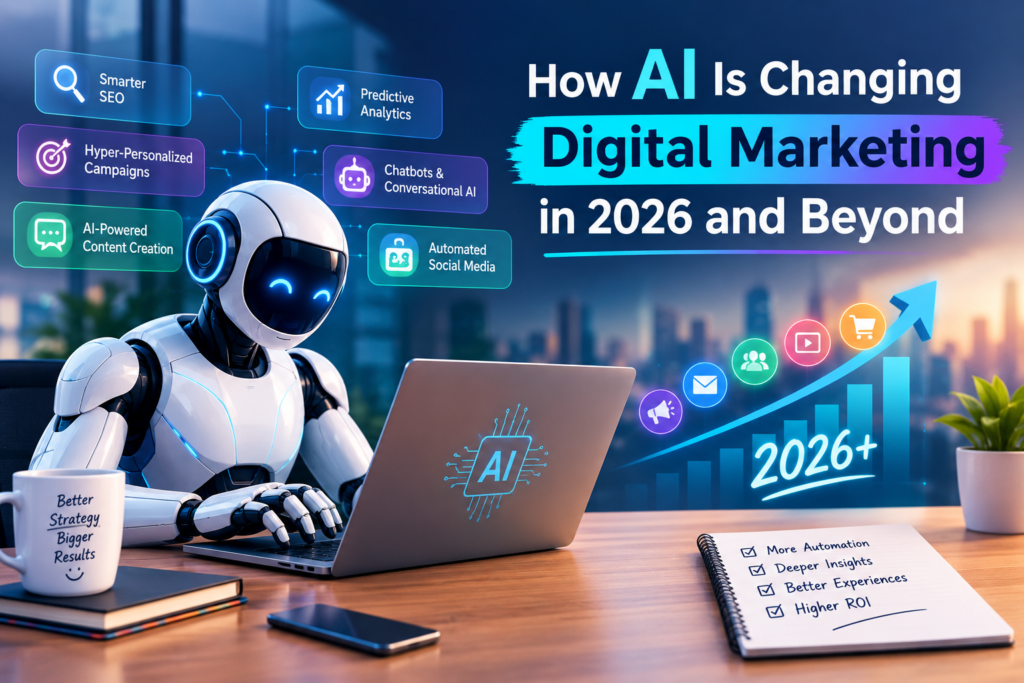
A few years ago, using AI in Digital Marketing meant experimenting with a chatbot or trying a caption generator out of curiosity. In 2026, it has become part of the everyday toolkit for marketers, freelancers and small business owners. From planning content to analyzing campaign performance, AI now supports work that used to take hours of manual effort.
This shift is not about machines replacing marketers. It is about marketers learning to work alongside AI to save time, generate ideas faster and make better decisions. Whether you run a fashion boutique in Kochi, manage social media for a Kerala based restaurant, or are just starting out as a digital marketer, understanding how AI fits into this space is becoming essential.
What Is AI in Digital Marketing?
AI in Digital Marketing refers to the use of artificial intelligence tools and technologies to support marketing tasks such as content creation, audience research, advertising, customer communication and data analysis. Instead of doing everything manually, marketers use AI to speed up repetitive work and get useful suggestions based on data.
This can include things like generating blog outlines, writing ad variations, analyzing customer behavior, automating email replies or personalizing website content. AI does not replace strategy. It supports it.
Why Is AI Becoming Important for Digital Marketers in 2026?
Digital marketing has become more competitive and more data heavy than ever. Consumers expect fast responses, personalized experiences and relevant content across multiple platforms. Meeting these expectations manually is difficult, especially for small teams or solo marketers.
AI helps by handling repetitive tasks such as drafting content, sorting data and monitoring performance, which frees up time for strategic thinking. This is one reason more businesses, including small and local ones, are exploring affordable AI tools rather than only large enterprises.
How AI Is Changing Content Creation
Content creation is one of the areas where AI in Digital Marketing has had the most visible impact. Marketers now use AI to assist with:
- Generating content ideas and topic lists
- Creating blog outlines
- Drafting social media captions
- Brainstorming video concepts
- Planning content calendars
- Doing quick research summaries
- Editing and improving grammar or tone
- Personalizing content for different audience segments
That said, human input remains essential. AI generated drafts often need editing for accuracy, tone and brand voice. A human touch is what keeps content authentic and aligned with what a brand actually stands for.
AI and Social Media Marketing
AI tools help marketers understand what type of content their audience engages with, suggest posting times and generate content ideas based on trends. They can also assist with analyzing comments and messages to understand audience sentiment.
For example, a Kerala based content creator could use AI to quickly brainstorm reel ideas around a local festival, then refine the concept based on their own understanding of their audience and cultural context. The idea comes from AI, but the final creative direction still needs a human perspective.
AI and SEO
AI is influencing how search itself works. Alongside traditional SEO, marketers are now paying attention to AI search and a newer concept called Generative Engine Optimization, or GEO, which focuses on how content appears in AI generated answers rather than only traditional search listings.
This does not mean traditional SEO has become irrelevant. Search engines still value well structured, relevant and trustworthy content. AI simply adds another layer marketers need to consider, alongside keyword research, quality writing and good website structure.
AI in Digital Advertising
In advertising, AI is commonly used for audience targeting, ad copy variations, creative testing and campaign performance analysis. Instead of manually testing dozens of ad versions, marketers can use AI to generate multiple options and identify patterns in what performs better.
This is particularly useful for small businesses with limited advertising budgets, since it reduces the guesswork involved in testing different messages.
AI and Customer Experience
Chatbots, automated replies and recommendation systems are now common on websites and social media pages. These tools help businesses respond to customer queries faster, even outside business hours.
An online store, for instance, could use a simple AI chatbot to answer common questions about delivery time or return policy, while more complex queries are still handled by a human team member.
Benefits of AI in Digital Marketing
- Saves time on repetitive tasks
- Speeds up content ideation
- Supports automation of routine work
- Improves personalization at scale
- Helps analyze data more efficiently
- Increases overall productivity
- Enables faster decision making
Challenges of Using AI in Digital Marketing
AI is useful, but it comes with limitations that marketers should keep in mind.
- AI generated information can sometimes be inaccurate and needs fact checking
- Content can feel generic if used without editing
- AI cannot fully replicate human emotion or lived experience
- Overdependence on AI can weaken a brand’s unique voice
- Privacy concerns exist around data used by AI tools
- Human review remains necessary before publishing AI assisted content
AI and Human Creativity
AI in Digital Marketing works best as a tool, not a replacement for human creativity. Strategy, storytelling, emotional understanding and cultural context are areas where human marketers continue to add irreplaceable value.
A brand’s personality, tone and the trust it builds with its audience often come from human decisions, not algorithms. AI can support the process, but it cannot replace the judgment that comes from experience and cultural understanding.
The Future of AI in Digital Marketing
Looking beyond 2026, AI is likely to become even more integrated into everyday marketing workflows. It may become more common to see AI assisting with deeper personalization, faster campaign testing and more advanced content planning.
These are possibilities rather than certainties, since technology and consumer behavior can change in unexpected ways. What seems more likely is that marketers who combine AI skills with strong human creativity, strategic thinking and originality will be better positioned for the future.
Conclusion
AI in Digital Marketing is not about replacing marketers. It is about giving them better tools to work faster, think more clearly and make informed decisions. From content creation to SEO, advertising and customer experience, AI is becoming a practical part of everyday marketing work, including for small businesses in Kerala and across India.
The marketers who benefit most will be those who learn to use AI thoughtfully, while continuing to rely on their own creativity, judgment and understanding of their audience.